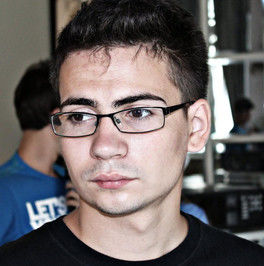
Adrian Bulat
Adrian Bulat
Principal Research ScientistSamsung AI Center Cambridge
Adrian Bulat is a Principal Research Scientist at Samsung AI Center Cambridge. His research interests include visual perception, multimodal understanding, and generative modeling. Across these areas, he explores how model design and learning methods can make foundation models for vision and language more efficient in their use of computation, memory, and data.
He received his PhD in Computer Science from the University of Nottingham, supervised by Georgios Tzimiropoulos in the Computer Vision Laboratory. He previously earned a BEng in Computers and Information Technology, majoring in Computer Engineering, from Gheorghe Asachi Technical University of Iași.
Experience
-
2018 – Present
Research Scientist
Samsung AI Cambridge
Leading research to advance the science and technology of intelligent machines with a focus on unsupervised learning, human understanding and efficient deep learning methods.
-
2016 – 2018
Teaching Assistant
University of Nottingham
G52CPP: 2nd-year C++ Programming. G53SEC: 3rd-year Network Security.
Education
-
2015 – 2018
PhD in Computer Science
University of Nottingham
Part of the Computer Vision Laboratory, focused on human analysis: face alignment, human pose estimation, face super-resolution and 3D face reconstruction.
-
2011 – 2015
BEng in Computer Engineering
Technical University "Gh. Asachi" Iasi
Computers and Information Technology, major in Computers Engineering.
Yes, but is there a story?
Of course, there is one, even when there appears to be none.
The story began some twenty years ago, with a little guy who decided to see daylight during the night. Not one of my brightest ideas — but hey, it was my first time being alive. A few years later, while watching the sky, I started dreaming about counting uncountable infinities and travelling through space and time. Nothing simpler than that. Soon after, a computer began to light up my desk at night, accompanied by the clatter of the keyboard. I still remember Windows 95 crashing as I tried to save a game — the worst feeling ever as a kid. Leaving that behind, I happily played classics such as Bomberman, Mario, and Tarzan. What a time to be young! The years passed, the little kid started to grow, and suddenly I was in high school. Over the next few years I fell in love twice, wrote my first program (oh, mighty Pascal!), and drank my first beer (bleah!). Without even noticing, it was time to become the man the kid had dreamed of — and to stay the kid that man still dreams of being. And so my first year as an undergraduate began. I still remember a math professor reminding us that paper has no property to autocomplete itself, so we had to solve the equations ourselves, however scary they looked. I could fill countless pages with all of this, but the short version is that, four years later, I completed my studies and officially became a computer engineer.
Inspired by the dreams of a little kid, and by the desires and passions of an older me, I decided to follow those dreams — trying to push the boundaries of science, trying to make the impossible possible. Because, in the end, there is always a set of axes where everything is simple; you just have to find them.